
What is App Store Marketing?
App Store Marketing is a holistic growth system that connects how people discover your app, how they choose it in-store, how they experience it in-product, and how you retain and monetise them over time.
It’s not “just ASO” and it’s not “just paid”. It’s the whole journey - from first impression to loyal users becoming ambassadors - with ASO, paid acquisition, CRM/lifecycle, creative, data + measurement, and product all working together.
Start here
- A simple definition
- The full journey (discovery → ambassador)
- How the pieces tie together (sustainable growth loop)
- Organic: ASO (visibility + conversion)
- Paid acquisition: Apple Ads, Google, paid social
- Creative: message, proof, and iteration
- Product: activation, value moments, and habit
- CRM & lifecycle: retention, reactivation, advocacy
- Data & measurement: what to track and why
- A weekly operating cadence (how teams run it)
- Where to go next
1) A simple definition
App Store Marketing is the practice of improving your storefront performance and your downstream outcomes as one connected system.
In plain terms, it means you can answer these questions with evidence - and act on them quickly:
- Discovery: Are we showing up for the right intents (organic + paid)?
- Choice: When we show up, are we getting picked (store conversion)?
- Experience: After install, are users reaching a value moment fast enough (activation)?
- Retention: Do we keep them and bring them back (lifecycle/CRM)?
- Economics: Are we earning more than we spend (LTV/CAC, payback)?
If you treat any one of those in isolation, you’ll usually end up with the classic problem: buying installs into a leaky bucket - or “doing ASO” without ever moving revenue.
2) The full journey (discovery → ambassador)
A useful mental model is the full user journey, end-to-end:
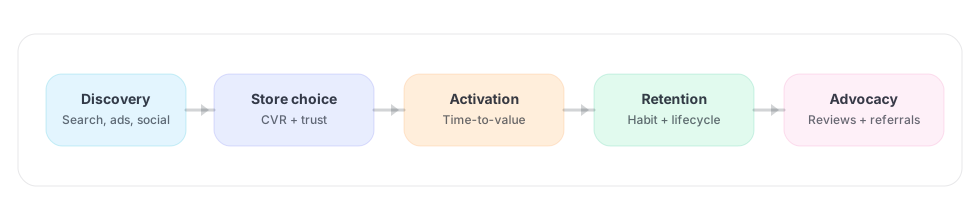
- Discovery: search, browse, ads, social, recommendations.
- Evaluation in-store: icon, screenshots, video, ratings, price, trust.
- Install + activation: onboarding, first session, time-to-value.
- Habit + retention: repeat use, reminders, feature adoption.
- Monetisation: paywalls, pricing, trials, upsell, subscription health.
- Advocacy: reviews, referrals, word of mouth, social proof.
“App Store Marketing” matters because the app stores sit right in the middle of that journey: they are both a discovery channel and the world’s most important product marketing page for mobile.
3) How the pieces tie together (sustainable growth loop)
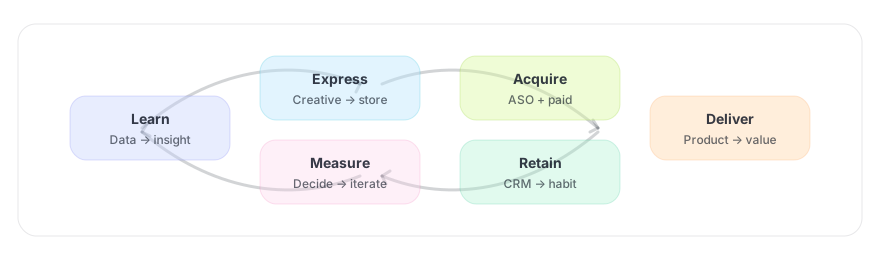
Teams that grow sustainably use a loop, not a checklist:
- Learn (what users want, what converts, what retains)
- Express it clearly (creative + store message-match)
- Acquire efficiently (ASO + paid acquisition)
- Deliver value quickly (product + activation)
- Retain and compound (CRM + lifecycle)
- Measure and repeat (data + iteration cadence)
This is very close to ConsultMyApp’s Sustainable Growth framing: acquisition and engagement are a partnership. App Store Marketing is the connective tissue - the part that ensures what you promise in ads/store is what users experience in-product, and what you learn in-product feeds back into acquisition.
Source references: CMA - Sustainable App Growth · CMA - Services overview
4) Organic: ASO (visibility + conversion)
ASO is the organic engine. But modern ASO isn’t just “rank for more keywords.” It’s:
- Intent mapping: which problems you solve (and for whom).
- Eligibility: showing up for those intents via metadata + category fit.
- Conversion: making the promise obvious in 1–2 seconds (icon + first screenshot).
- Trust: ratings, review themes, privacy posture, and proof.
ASO also acts as your “creative brief generator”: the best listings are just the clearest articulation of the value users are already looking for.
If you only do ASO, you can still grow - but you’ll hit ceilings faster because you’ll be learning slowly. That’s where paid comes in.
5) Paid acquisition: Apple Ads, Google, paid social
Paid isn’t just “fuel.” In a sustainable system, paid is also research.
- Apple Ads / Google App Campaigns: fast signal on which intents and messages convert in-store.
- Paid social / display: demand creation + audience testing (but still needs store message-match to land).
- Retargeting: bringing high-intent users back at the right moment (closer to CRM than acquisition).
The mistake is treating paid and organic as separate teams with separate truths. The win is feeding learnings both ways: paid teaches you what converts; ASO makes those wins durable; CRM + product make them profitable.
Apple vs Google: what changes
- iOS: Custom Product Pages (CPPs) let you match intent without bloating your default page.
- Google Play: Custom Store Listings + experiments can accelerate learning; descriptions matter more.
6) Creative: message, proof, and iteration
Creative is not “design polish.” It’s the mechanism that turns intent into action.
- Message: one clear promise (what you do + why it matters).
- Proof: credible evidence (feature demo, outcomes, social proof, differentiation).
- Match: consistency from ad → store → onboarding (no bait-and-switch).
- Iteration: a testing cadence so you don’t rely on taste.
A good rule: if your first screenshot doesn’t answer “is this for me?” instantly, you’re making users do work - and they won’t.
7) Product: activation, value moments, and habit
Product is where “marketing” becomes real. Your store promise must be delivered in the first sessions.
- Activation: shorten time-to-value (the first meaningful success moment).
- Adoption: guide users to the features that drive retention.
- Monetisation: align paywalls/pricing with value delivered (and with acquisition economics).
- Quality: stability and UX reduce refunds, churn, and review risk.
This is the part many “acquisition-first” strategies miss: you can’t out-market a weak first-run experience.
8) CRM & lifecycle: retention, reactivation, advocacy
CRM is how you compound. It turns one install into months (or years) of value.
- Onboarding journeys: help users reach a habit loop (not just complete steps).
- Lifecycle messaging: push, in-app, email - triggered by behaviour, not calendars.
- Reactivation: bring users back with the next best action (not generic promos).
- Advocacy: review prompts, referrals, community - turn satisfaction into social proof.
Reviews are the bridge between CRM and the store: great lifecycle + product creates the proof that helps future users choose you.
9) Data & measurement: what to track and why
The goal of measurement is not reporting. It’s decision-making.
Storefront (leading indicators)
- impression share (where you’re showing up)
- tap-through rate (relevance at the shelf)
- conversion rate (store page efficiency)
- ratings/review themes (trust + friction)
In-product (value indicators)
- activation rate (time-to-value)
- D1/D7/D30 retention (habit + fit)
- subscription health / repeat purchase / ARPU (economics)
- churn reasons + qualitative feedback (what to fix next)
Unit economics (the guardrails)
- payback window (how long to earn back CAC)
- incrementality (what you’re truly buying)
- segment-level ROI (which intents/audiences are worth scaling)
If you only measure installs, you’ll optimise for installs.
10) A weekly operating cadence (how teams run it)
A sustainable cadence is cross-functional but lightweight. One loop, one week:
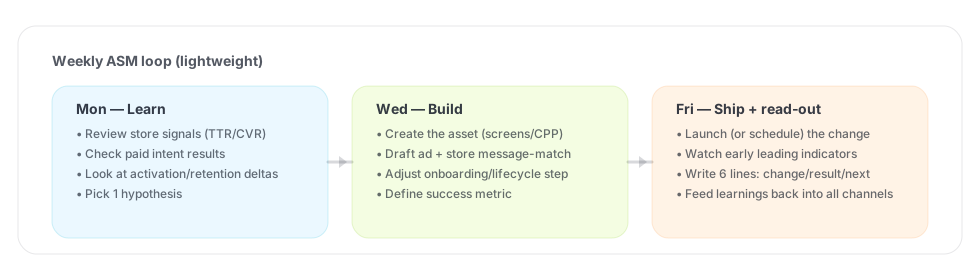
- Monday (Learn): review store + paid + retention signals. Pick one hypothesis to test.
- Midweek (Build): create the asset (new screenshot, CPP/CSL, ad variant, onboarding tweak, lifecycle message).
- Friday (Ship + read-out): launch, then write a short summary: what changed, what happened, what you’ll do next.
The “secret” isn’t doing more. It’s learning faster than competitors - without breaking your own measurement.
11) Where to go next
If you want to go deeper, these guides pick up each part of the system.
 ASO Guide 2026Visibility + conversion fundamentals
  Apple Search Ads GuideStructure, bidding, creative, incrementality
  ASO ChecklistA weekly routine you can actually keep
  App Marketing ToolsA practical stack for research + iteration
 Editor: App Store Marketing Editorial Team
Insights informed by practitioner experience and data from ConsultMyApp and APPlyzer.